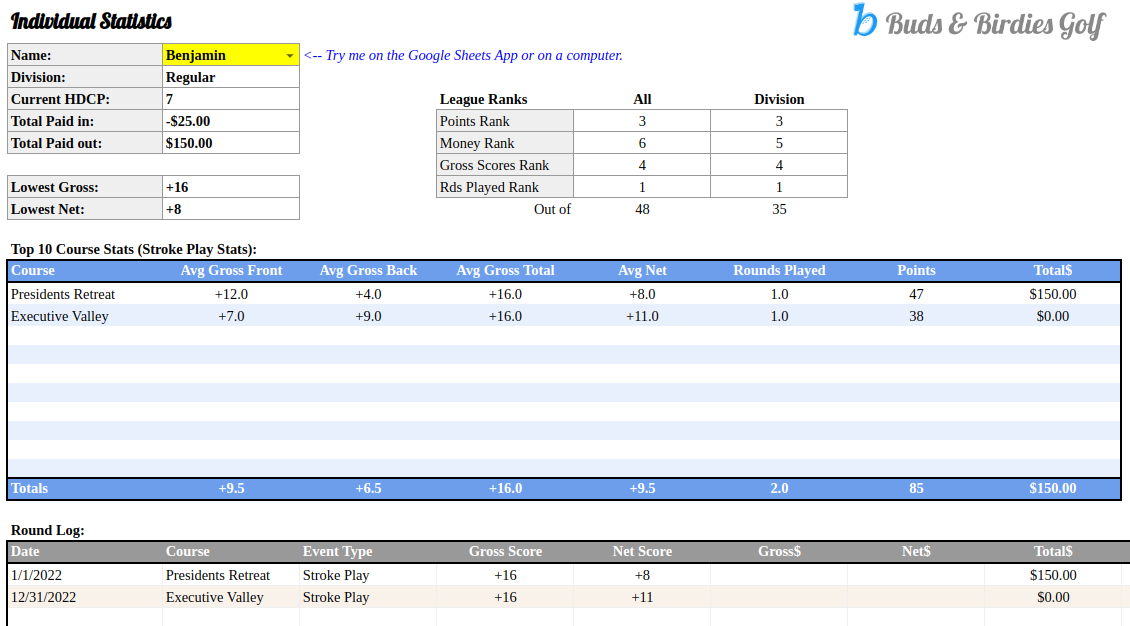
Access your league from your phone using the Google Sheets app!
Buds & Birdies Golf wants to enhance your golf league! I share a few options to help automate or streamline your league:
Basic Golf League – $20
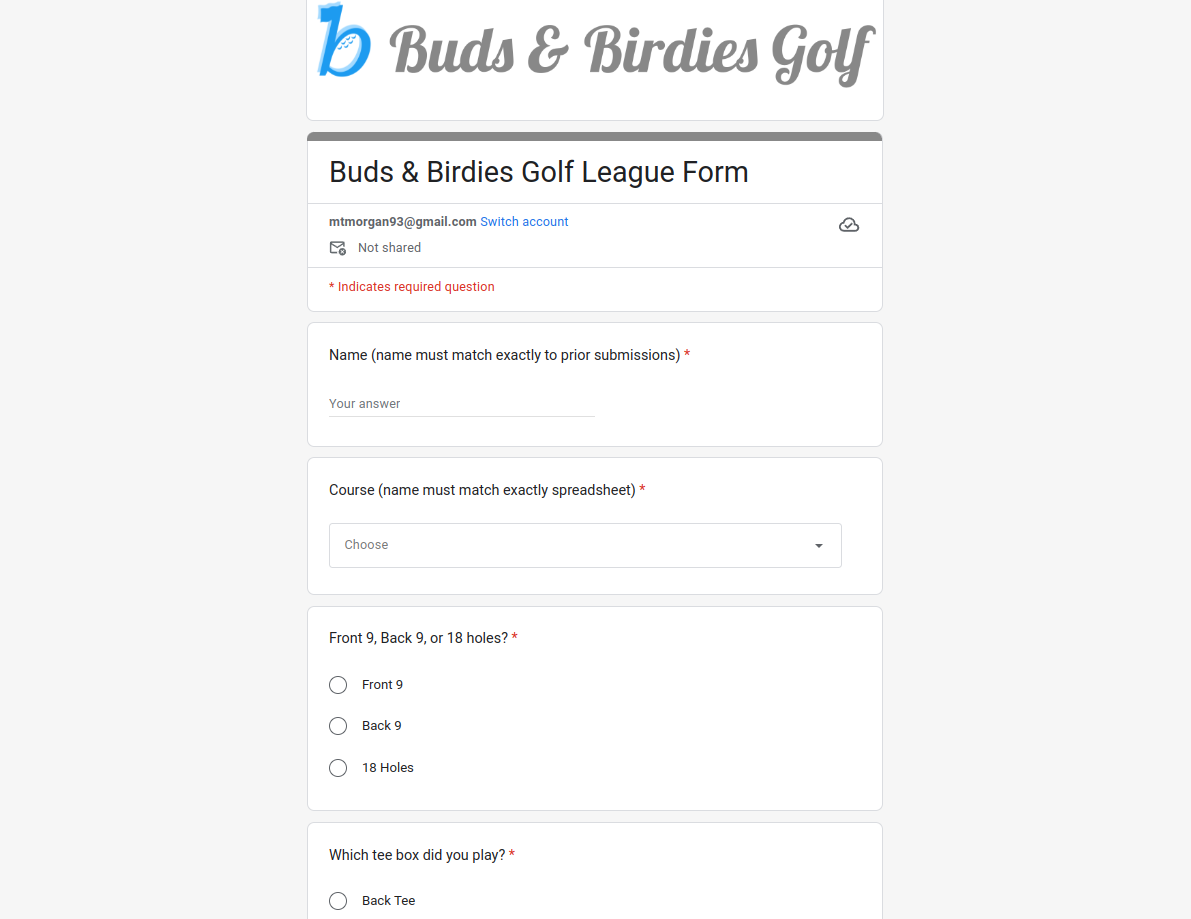
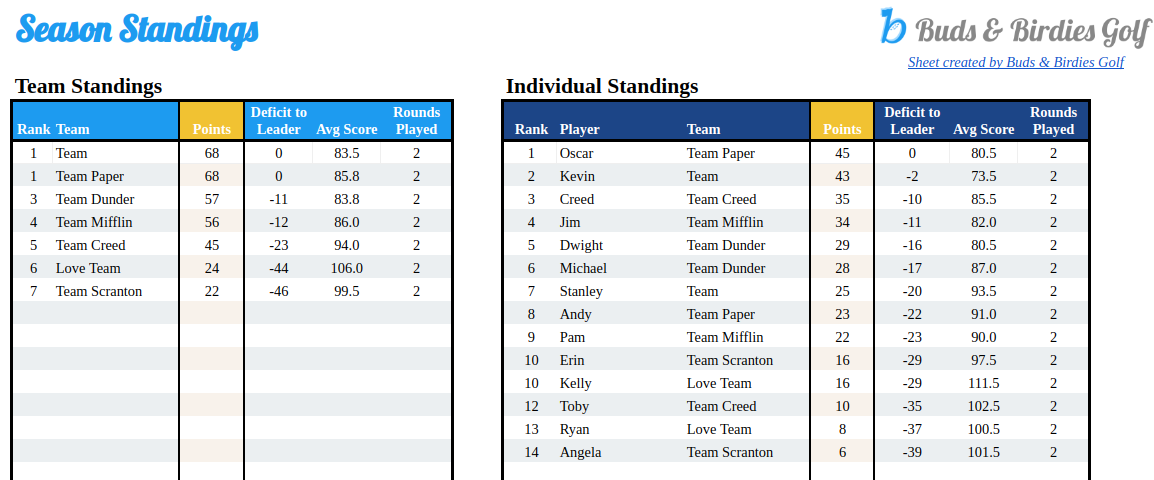
League members submit gross scores throughout a season to compete for playoff seeding. Individuals submit their own scores using a Google form and the league standings update automatically! Great for busy schedules because there is no requirement to play on the same day, at the same course, or even from the same tees!
League members team up to maximize team points throughout the season. Common scoring formats include Quota and Stableford, and scoring can be gross or net of handicaps. An optional individual points competition is also tracked.
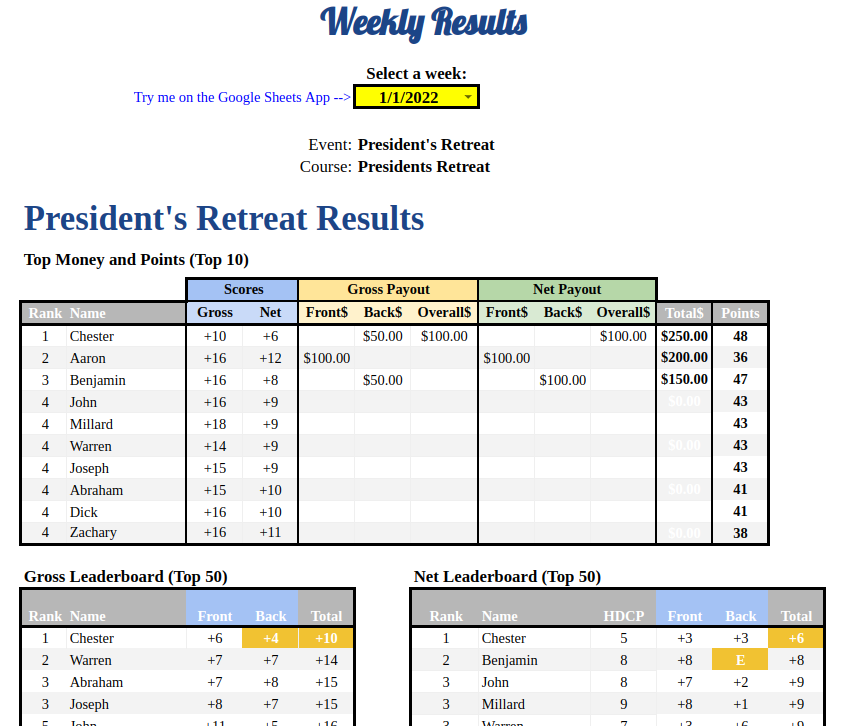
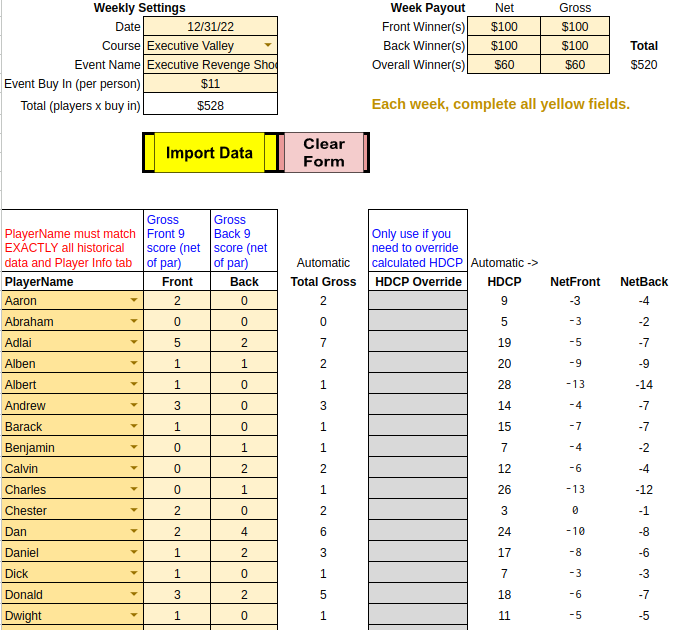
League members compete in multiple net and gross stroke play competitions each week. Points and money are earned each week based on weekly results. This league is great for groups who want to play regularly, have access to the same courses, and enjoy weekly and season-long competitions (as well as optional gambling).
“Dogfight” is a weekend-long points-based competition won by the individual who scores the most points over all rounds. Games will be played as two-man teams, four-man teams, or as individuals. Points are awarded after each 9-hole game on Saturday and after the 18-hole Calcutta on Sunday. Cash bonuses will also be earned by winners during each game on Saturday. All games are a variation of net stroke play and handicaps will adjust after each game to help level the playing field. The individuals with the most points at the end of the weekend (1st-3rd) will win cash.
How to win Money
This example uses a $30 buy-in for 12 players over three 18-hole rounds. A total pot of $360.
There are 3 ways to win money:
Overall Dogfight winners
The players with the 1st, 2nd, and 3rd most Dogfight points at the end of the week win $70, $30, and $20, respectively.
Games 1-4 winners
The winning team of each 9-hole game is awarded $15 per player.
Head-to-Head winners
The head-to-head winning team within each group is awarded a bonus of $5 per player (N/A for games 4 and 5).
Dogfight Games (5 games total over 54 holes)
Round 1:
Game 1: Best Ball stroke-play (Round 1, Front 9)
Each 2-man team takes its lower net score per hole.
Points are awarded based on the final standings of all 6 teams and a cash bonus is paid to overall and head-to-head winners.
Game 2: Combined stroke-play (Round 1, Back 9)
Each 2-man team combines both net scores per hole.
Points are awarded based on the final standings of all 6 teams and a cash bonus is paid to overall and head-to-head winners.
Round 2:
Game 3: Vegas (Round 2, Front 9)
Each two-man team pairs its two net scores, starting with the lower score.
Example: a net 6 and 4 are paired to make a 46.
Triple Bogey Max penalty does not apply for this game.
Points are awarded based on the final standings of all 6 teams and a cash bonus is paid to overall and head-to-head winners.
Game 4: 4v4v4 Low-Ball, High-Ball (Round 2, Back 9)
Each group makes up a team of 4.
The 4-man team combines its highest and lowest net scores per hole.
Points are awarded based on the final standings of all 3 teams and a cash bonus is paid to the overall winning team.
Round 3:
Game 5: Individual Net Stroke Play (Round 3, All 18)
Each individual plays an 18-hole net stroke-play competition.
Points are awarded to each individual based on final standings.
We play Round 3 as a Calcutta, so no cash bonus is awarded for the Dogfight competition.
Dogfight Points
Each of the 5 Dogfight games has a set number of points that are awarded based on each team’s finishing position (see points distributions below). An additional point is awarded to the individual with the lowest net stroke-play score every 9 holes. Each individual’s points are aggregated over the entire weekend. The top 3 individuals win cash.
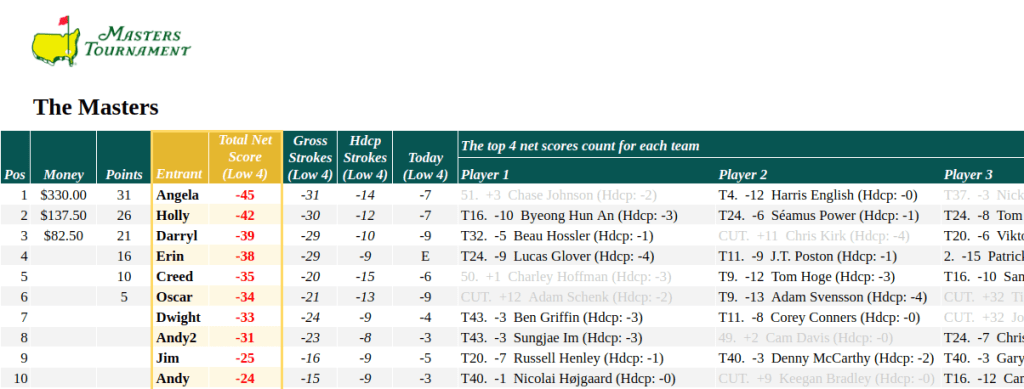
New and improved! Welcome to the PGA Tour Betting Pool spreadsheet created by Buds & Birdies Golf! This sheet now allows you to set up your pool in a variety of different formats, including different draft types (Tiered, Handicapped, or Straight up), team sizes (ranging from 1-10 players), and prizes (points, money, or both). Want to play again? Now you can save your event results from each tournament and aggregate points and/or money over the length of an entire season!
How to play: Each entrant will draft a number of PGA players to their team. Each team’s top # scores (# = league admin’s choice) will count towards their overall aggregate score. At the end of the tournament, the team with the lowest aggregate score wins!
This template can be used for any stroke-play golf event with an ESPN leaderboard! Both the Tournament Leaderboard and the Pool Leaderboard update automatically so that you can enjoy your pool without the administrative burden!
Check out the images below to see it in action!
Easy-to-follow instructions and screenshots help guide you through the setup process.
The Pool Leaderboard updates automatically to show money, points, and scores. It can be applied with one of several themes, including all four majors, the FedEx cup, and a generic PGA tournament theme.
The Tournament Leaderboard is connected directly to espn.com and updates automatically every 10 minutes.
Save results for each event to track your pool’s standings over a season. Want to play again next year? This sheet can be reused for additional seasons.
Like what you see? I offer two pricing levels:
Option A – $50 – Betting Pool League (lifetime access): For the whole shebang, including the ability to run a betting pool for any PGA event and aggregate league results into a “Betting Pool Season” or “Fantasy Golf Season” then this option is the best bang for your buck. When next season rolls around, simply update your “Season name” and run it back within the same spreadsheet!
Option B – $19.99 – Single Event: If you only plan to run a betting pool for a single event (most likely The Masters or another major), then these themed options are best for you:
New and improved! Welcome to the PGA Tour Betting Pool spreadsheet created by Buds & Birdies Golf! This sheet now allows you to set up your pool in a variety of different formats, including different draft types (Tiered, Handicapped, or Straight up), team sizes (ranging from 1-10 players), and prizes (points, money, or both). Want to play again? Now you can save your event results from each tournament and aggregate points and/or money over the length of an entire season!
How to play: Each entrant will draft a number of PGA players to their team. Each team’s top # scores (# = league admin’s choice) will count towards their overall aggregate score. At the end of the tournament, the team with the lowest aggregate score wins!
This template can be used for any stroke-play golf event with an ESPN leaderboard! Both the Tournament Leaderboard and the Pool Leaderboard update automatically so that you can enjoy your pool without the administrative burden!
Check out the images below to see it in action!
Easy-to-follow instructions and screenshots help guide you through the setup process.
The Pool Leaderboard updates automatically to show money, points, and scores. It can be applied with one of several themes, including all four majors, the FedEx cup, and a generic PGA tournament theme.
The Tournament Leaderboard is connected directly to espn.com and updates automatically every 10 minutes.
Save results for each event to track your pool’s standings over a season. Want to play again next year? This sheet can be reused for additional seasons.
Like what you see? While I do not have a way to offer a free trial, I do offer a money back guarantee. If the sheet is simply just not for you, let me know and I’ll return your money.
I offer two pricing levels:
Option A – $50 – Betting Pool League (lifetime access): For the whole shebang, including the ability to run a betting pool for any PGA event and aggregate league results into a “Betting Pool Season” or “Fantasy Golf Season” then this option is the best bang for your buck. When the next season rolls around, simply update your “Season name” and run it back within the same spreadsheet!
Option B – $19.99 – Single Event: If you only plan to run a betting pool for a single event (most likely The Masters or another major), then these themed options are best for you:
After years of tinkering with our annual golf trip competition, there is one event that stands out as an all-around favorite: The Calcutta. This event will have a huge positive impact on the quality of your golf competition! Below I’ve shared why we enjoy it so much!
What is a Calcutta golf tournament?
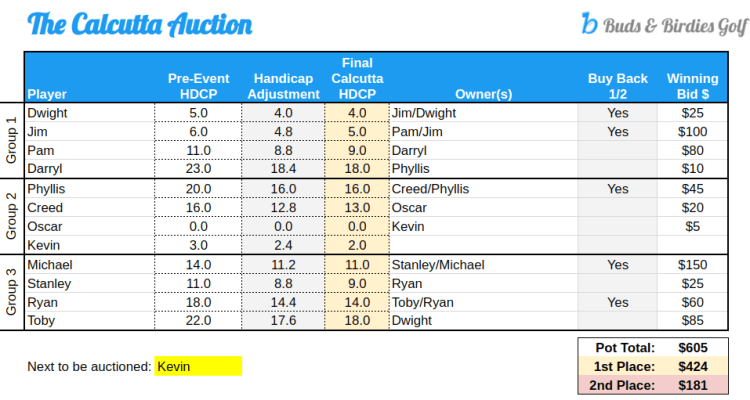
A Calcutta golf game is a handicapped golf event where any competitor can “buy” another competitor in an auction. This auction is usually held the night before the Calcutta round and the owner of the winning player wins the money. When played as the final round of a golf trip, previous rounds can be used to set Calcutta handicap values (we typically use a mix of prior rounds and estimated or actual handicap). This allows high-handicappers, or low- to mid-handicappers who haven’t been playing well, a chance to contend for the tournament!
Why Play a Calcutta?
No matter the player’s skill level or the quality of their recent play, anyonehas a chance to win the (hopefully) large pot of money collected during the Calcutta Auction. This is true for two reasons:
A Calcutta is a handicapped event that levels the playing field for all competitors.
Even if you don’t feel confident with your calculated handicap, you still have a chance to “pick the winning horse” during the Calcutta Auction.
During our 2020 event, our worst golfer, who sold for a measly $15 and didn’t even bother to buy half of himself, shot a career-best round of 106 to win the Calcutta by net two shots! That $15 bet won over $400!
The Calcutta tournament can be broken down into 2 parts:
The auction may be as much or more fun than actually playing the event! Your group’s super-competitive players will be sure to talk trash and your gamblers (and/or those who have had one too many drinks) will enjoy dropping large sums of cash on their friends!
Once handicaps are set, give your group some time to look them over and analyze who they want to bid on. Then, randomly choose players to be auctioned off. You may be surprised by how much players sell!
Once a player is bought in a live auction, they have the option to buy 50% equity in themselves for half the bid price. Beware of any player who doesn’t take a half-stake in themselves- they’re probably not feeling too confident!
The owner(s) of the first and second-place players split the pot 70%/30%. Be sure to track who the owner is, how much they bid, and whether the player took a half-stake in themselves!
The Calcutta Auction and Virtual Scorecard:
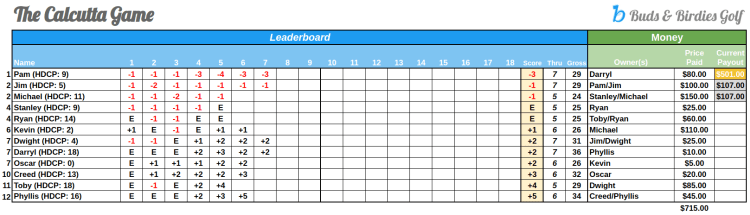
Large amateur golf events make it difficult to know how well your competitors are playing or where you stand. By using a virtual scorecard (hosted on Google Sheets), you can track the hole-by-hole scores of everyone on your trip with an automated leaderboard! Your group will love following along with everyone’s scores and your group’s Calcutta leaders will sweat as they play the last few holes knowing they are one mistake away from blowing a large sum of cash.
Everything you have read above can be done in a Buds & Birdies Golf spreadsheet! Use this tool for calculating handicaps, running the auction, and automating a virtual leaderboard! Check it out here:
A lot goes into planning a golf trip. You’ve booked your tee times, collected handicaps, decided on the type of matches to be played, and set up (or paid for) a virtual scoreboard. But there is one additional project that promises to increase the fun and will take your trip to the next level: the “Prop Bet Pool.”
A prop bet, or “proposition” bet, is a bet on an event that takes place during the round, unrelated to the direct outcome of the competition. Prop betting allows everyone in your group, regardless of how well they or their team plays, the opportunity to win money. See examples in the list below!
By pooling all prop bets together and using a point system to calculate the winner, you avoid the mistake of too many side bets overshadowing the team and individual competitions.
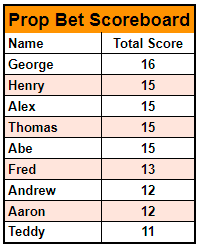
This year, we had 20 prop bets plus a tiebreaker composed of 30 points. Nine players pooled $2 each and the winner took home the pot after scoring the most points (scoreboard pictured).
Try to have a personalized prop bet for every player on your trip so that everyone gets excited about it!
If you know a player well and are familiar with his skill level, his prop bet can be more unique. Such as:
Bad Ball Striker (and/or really nervous): Will Henry top his drive on #1? (Put him in the first group so everyone can watch)
Bad Putter: How many 4-Putts will Alex have on Saturday (including putts from off the green)? O/U 0.5
Great off the tee: How many fairways does Honest Abe hit on Saturday? O/U 10.5 (out of 14)
Big Drinker: How many beers does Fred drink before the drinking game starts? O/U 6.5
If you are less familiar with a player, you may be better off sticking with questions like these:
Signature Par 3: Will George hit the green on the iconic #14 par 3? (#14 – 160 yds off a cliff)
Tough Drive: Does Teddy use a breakfast ball on the #1 tee?
Drinking Game: How many beers does Thomas drink during the drinking game? O/U 4.5 beers
Finally, include some overall competition bets worth higher point values. While these are less fun, they are much harder to predict and the higher point value will provide some deviation in scores. Try these:
Which of these players will have the highest round 2 gross stroke play score (the drinking game round)? Sober Abe, Drunk Alex, Drunk Fred, or Drunk John
Who will win the most money in Snakes on Saturday?
Over-under? Lowest gross score on Saturday = 75.5
Over-under? Highest gross score on Saturday = 116.5
Who will win the MVP? (most team points scored by an individual)
Who will win the overall gross stroke-play score: George vs field
Which team will win the team event?
The great thing about a prop bet pool is that bets are unique to individuals on your trip. It gets the gambling juices flowing and provokes smack talk about which are the best and worst bets. Plus, it’s always fun to see some guy extra sweaty for his opening tee shot!
What are some of your favorite prop bets on the golf course?
The biggest problem with planning a handicapped golf trip or event is that most weekend golfers don’t have an official or unofficial handicap.
Unfortunately, an official USGA-qualified handicap costs between $20-$60 per year and requires you to be a member of a golf club (but not necessarily a “country club”). While this probably isn’t going to break the bank, you don’t need an official handicap unless you plan to play in local club events, state golf association events, or USGA events. However, knowing your accurate handicap is a great way to make your golf matches and trips more competitive!
If you do plan on playing in events requiring a USGA handicap, check out USHandicap.com to get your official USGA handicap online for $30. This works great if you’re in a pinch and need your official handicap before you tee off in the morning!
You can also use an app called TheGrint, which allows you to track scores, keep stats, and use its built-in course GPS feature. While unofficial handicap tracking is free, you can convert it into a USGA-compliant handicap for $20 per year.
If you’re content with being unofficial, but still want to know your handicap (it’s probably lower than you think!) or want others in your golf group to calculate their handicap before the big golf trip, my free Buds & Birdies Handicap Calculatorallows you to update and track your handicap from anywhere without having to give any pesky apps your information!
Once you open the Google Sheet, all you have to do is select “File” then “Make a copy” and this baby is all yours! You can access it from anywhere using the Google Sheets App on your phone or going to your Google Drive on your PC. The formulas are protected, but if you’d like to explore them or make any adjustments, no password is required to unlock them!
Since this handicap calculator is for your personal reference, be honest with yourself. Play by USGA rules (no mulligans) or alternate rules and report ALL of your scores, no matter how good or bad. Remember, the new maximum strokes-per-hole limit is a net-double bogey (so move on to the next hole after knocking three in the pond!).
My annual golf trip is the apex of my golf season. For months leading up to it, I scour the internet for slice-fixing drills, I analyze my swing using my iPhone’s slow-motion camera, and I skip the course to instead hit the chipping and putting areas. This year, I even bought a putting mat for my living room to solidify my 5-footer confidence. And I’m not the only one pumped for our annual trip. We have guys making promotional flyers (a form of taunting using Photoshop), hype videos, and our team captains held multiple Zoom meetings to discuss rules, draft teams, and talk smack.
With several years of experience hosting golf trips, here is a list of 10 best practices that will lead to the ultimate golf trip.
1. Choose a good location
You don’t have to go to Bandon Dunes or Pinehurst for an awesome golf trip. However, location is important. Choose a location with several quality golf courses within a short distance of each other. The Robert Trent Jones Golf Trail, Fairfield Glade, and many metropolitan areas can be hosts to a great weekend.
2. Set the right schedule
When scheduling your tee times, it’s important to know the energy level of your group. Even for shorter trips, 36-hole days can still be brutal depending on the weather. We suggest playing a “fun” afternoon round. Find a good par 3 course to play barefoot, include a drinking game on the scorecard, or play a 2- or 4-man scramble to mix up the afternoon rounds.
3. Include clusters of skill levels
You want to invite people who both fit in with the group and have comparable skill levels to at least two other members of the group. Handicapping is a great way to level the playing field, so don’t be afraid to invite some higher or lower handicappers if you feel they will be a good addition to the group. It is best to avoid non-golfers, no matter how well they get along with the group. You, they, nor the group behind you, will enjoy the trip.
4. Choose the right games
There are a lot of golf games out there. We typically play 9-hole matches and swap games after each nine. Each individual hole can be played as a point for your team (9 points per 9-holes) or each 9-hole match can be played as a point for your team (1 point per 9-holes). Choosing a point system typically depends on how many teams are involved and how many rounds will be played.
Here are a few of our favorite games for team events:
Best Ball Match Play – best for opening rounds while high-handicappers dust off the cobwebs.
Low Ball, Low Total (+1 birdies, +2 eagles) – a high-scoring format that involves both members of each pairing and incentivizes more aggressive play.
Stableford or Quota – great for an afternoon round (because double bogey max) and pairs nicely with a drinking game.
Singles Match Play – a group favorite- match players up with a bitter rival.
Alternate Shot – great if you’re not playing a stroke play event at the same time.
I typically start organizing the competition by choosing the number of teams. For a group of 12, we typically play 6 vs 6. This year, however, we played 3 teams of 4. While a bit more work, I found 3 teams of 4 more enjoyable because each member has more impact on the outcome (1/4th of the team score as opposed to 1/6th). Once the number of teams is set, choose your captains. As the “game-maker,” you may think it would be best to set teams and match-ups. While this may be true, it is much more fun to pick captains and allow them to draft their own teams. This also allows you to do some arbitrary handicapping (estimating a handicap for someone who doesn’t play enough golf to have a handicap) without being accused of “rigging” the game. More on handicapping in the next section.
6. Take the pressure off of handicapping
Set handicaps for each player prior to the draft, then allow the captains to draft players based on the captain’s perceived value of each player. For example, if Captain A believes Jack is getting more strokes than he deserves, he is more likely to pick him in an earlier round. This takes all the pressure off of accurate handicapping. This is important because many weekend golfers don’t have official handicaps. View my article on how to calculate your official or unofficial handicap. What you’ll likely find is that captains will take the best golfers first regardless of handicap. In my experience, this is a mistake. Captains should seriously consider taking a higher-handicapped, more volatile player over the scratch golfer. While the handicapping of the draft pool of players doesn’t have to be perfect, try to make sure your captains have fairly accurate handicaps (relative to each other) to avoid any major difference in captain value. If you still want to improve your group’s handicap estimations, consider setting up a golf league with your friends!
7. Simplify the rules
If you have a group of die-hard competitive golfers in your group, skip this section. Otherwise, consider playing by alternate rules to make play more fun and to speed up the pace of play. Here are a few of the favorites that we always play by:
Alternative Out of Bounds and Lost Balls – We usually play everything (OB, unmarked tall grass or thick woods) as if it were a lateral water hazard (“take relief back on a line behind any water hazard (Rule 26-1b) or within two club-lengths of where a ball entered a lateral water hazard.”). This keeps from having to go back to the tee to replay a shot and is especially important on tight courses. For more serious players, you may prefer to play by the new Alternate OB rules which are much less forgiving (2-stroke penalty instead of one).
Triple Bogey Max – For better groups, you may want to consider a double bogey maximum. However, for groups with multiple players shooting their temperature or worse, a triple bogey max gives them a little more to play for.
Play it up / Free Relief – Nobody wants to scratch their brand new Vokey wedge chipping off of a rock. Allowing a scorecard length relief from rocks and tree roots prevents both club damage and cheating (because someone in your group will do this anyway). If you want to eliminate the chance of illegally improving lies, play it up everywhere!
Gimmes – In a pressure-packed final round with big (or small) money on the line, gimmes may take away from the fun. However, in early rounds, we tend to play putter-length or inside-the-metal-length gimmes to speed up play.
8. The Calcutta – End things with a bang
Full disclosure: this is my favorite. A Calcutta is a handicapped event where other members of the group get to “buy” players in an auction prior to the Calcutta round. We play this during our last round of the weekend so that we can use prior rounds to set handicaps. Once a player is bought in a live auction, they have the option to buy 50% equity in themselves for half the bid price. This year, our worst golfer, who went for a measly $15 and didn’t even bother to buy half of himself, took home the victory (but not the cash). His “owner” was kind enough to give him a portion of the thirty-fold winnings. Visit my post on How to Improve Your Golf Trip – “The Calcutta” (with virtual scorecard)! to learn how to set up your Calcutta with a virtual scorecard!
9. Create a one-pager with the schedule and rules
Organizing your golf trip is not easy. Even harder: explaining the competition to your peers. Be sure to print off a one-page sheet that lists the teams, tee times, games, and rules. Simply telling your group to look at your email or the shared Google Doc will not work (I know from experience). Printing it out will save you time and effort having to re-explain the rules to your group and other groups during your round.
10. Include “extra stuff” for “extra fun”
Every year we mix up our games and add a little more flair to our event. Here are a few that have worked well:
Prop Betting Pool – Use a Google Form to set up “prop bets.” One of the highlights of this year was “Will Player X top his first tee shot?” On the first tee (and the night before), he was sweating bullets thinking about his opening tee shot with all 11 others watching him. I wish I could tell you this is a feel-good story of overcoming his fear, but…his tee shot didn’t go 20 yards. Sorry X. Check out my post on Prop Bet ideas!
Virtual Scorecard – This was a game-changer. Having a Google Sheet that automatically converted handicaps (no math!) and kept up with live scoring allowed everyone to know where they and their team stood in the standings as our team event came to a close. Knowing “we are trailing by 3 going into hole number 18” or “I need to birdie number 18 to win” was very exciting and much more efficient than trying to communicate the score through a stream of text messages. I will have future posts on how to set up a Virtual Scorecard with a Google Sheet, so please subscribe!
Snakes – We play Snakes differently. It gets personal. In this game, you can choose to call “snake” on any player prior to him approaching his putt (defining “approach” is a gray area that has led to some minor conflict). If he three-putts or worse, he gives you $1. Otherwise, you pay him $2 for converting a difficult two-putt. There are many variations of Snake. While this one is easier on the wallet than most, it does allow for some gamesmanship about who, when, and how often to sound the dreaded “snake” call.
Conclusion
Teams are set. Smack talk is blowing up your iPhone and your 10-handicap friend is trying to convince the group he’s playing at a 4 (he won’t break 90). You’ve got a few sleeves of your favorite performance golf balls (my favorite is the Srixon Z-Star) all marked up and ready to go. The trip hasn’t even started yet and you already feel like the trip is a success. You’ve put in the time to organize everything and gone the extra mile to make things fun. Now it’s time to enjoy the spoils of your hard work! Hopefully, you didn’t forget to practice while planning your trip!
Please let me know in the comments what else should be added to this list!













 Buds and Birdies Golf